
Next-Generation Tools for Time-Domain Astronomy
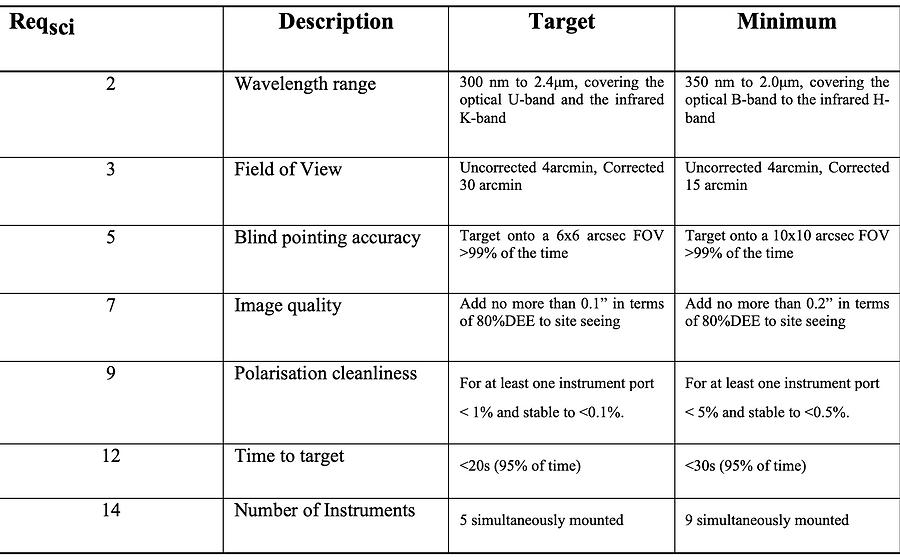
The NRT will perform fast follow-up observations of transients in the new era of multi-wavelength synoptic surveys. The telescope design specification allows an operable wavelength range of 300 – 2400 nm, while delivering an image quality not exceeding site seeing + 0.2 arcseconds in terms of 80% diffracted encircled energy.
The time-to-target requirement following an alert is 30 seconds and as such the instrumentation should allow the object to fall onto the detector FOV within the blind pointing accuracy of the telescope (10”x10”; 99.9% of the time minimum).
The instrumentation for the NRT will be stable, efficient and cater to the needs of the time-domain community. Light from astronomical sources can be probed in six dimensions: through two polarisation states, temporally, with respect to wavelength dependence, and intensity in the two spatial directions as projected on the sky.
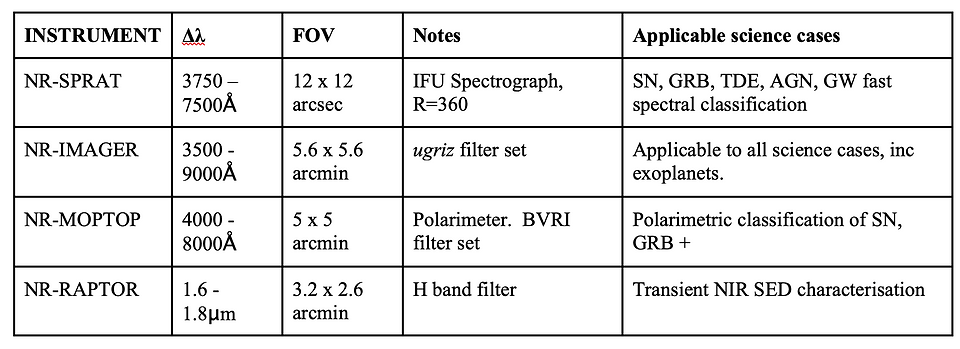
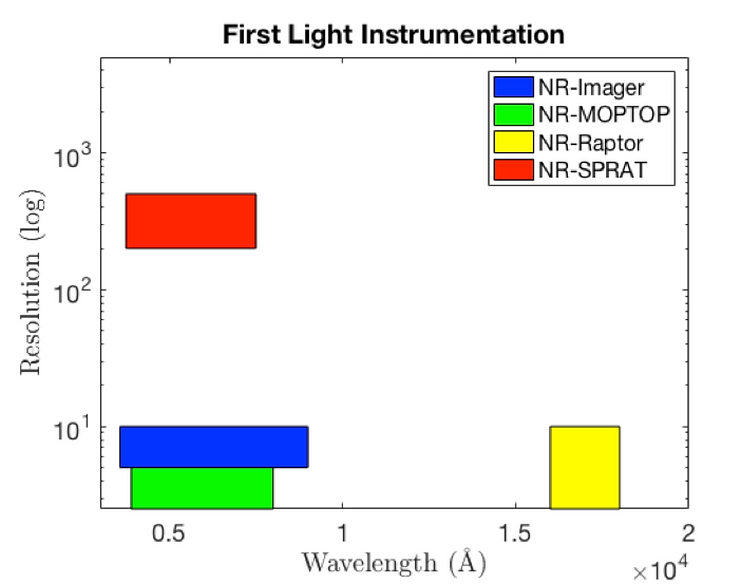
The first light instrumentation will likely be a set of low-cost, simple, high-throughput instruments designed to deliver the NRT science cases. The first light suite will consist of spectroscopic and photometric capabilities (e.g. NR-SPRAT and NR-IMAGER) as well as the transfer of two existing instruments from LT to NRT (NR-MOPTOP and NR-RAPTOR) to cover polarimetry and near-Infrared (NIR) imaging.
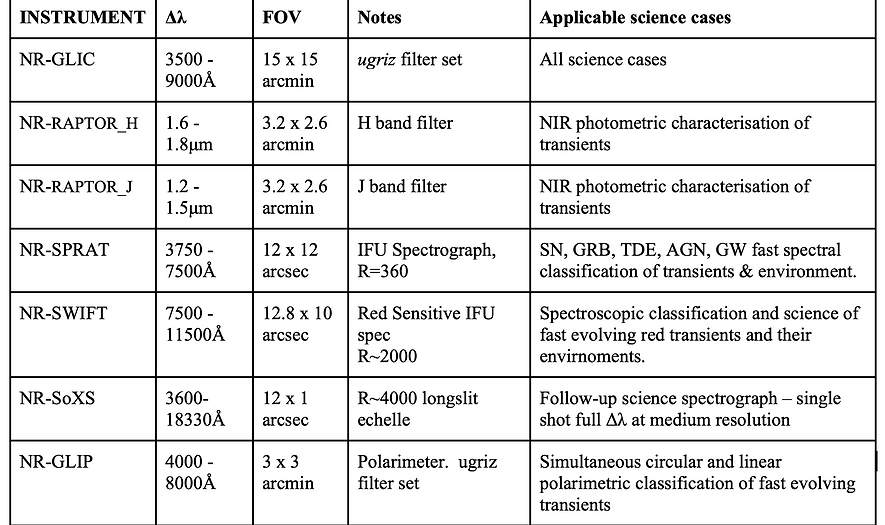
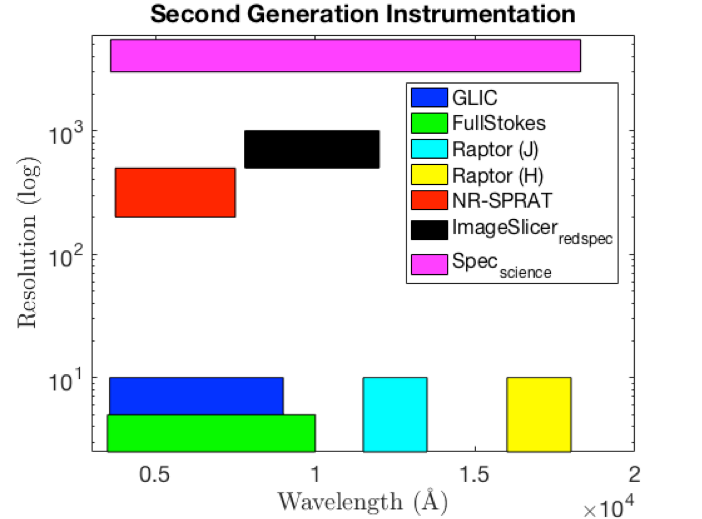
The proposed second generation of instrumentation is designed to complete the overall science requirements of the project. The major additions to the instrumentation suite are the introduction of a wide-field camera, a red, sensitive, imaging spectrograph, a medium-resolution, single-shot, broad-wavelength spectrograph and a full Stokes polarimeter.
The NRT will also require non-science instrumentation which support observations, particularly the autoguider and Wavefront Sensor (WFS).
A wavefront sensor (WFS) measures the “flatness” of the image we obtain at the detector. By taking a “slice” of the beam of light, one can measure if some light is deviated. In our case, we are making sure that all 18 segments of the primary mirror are aligned to one another to make a primary mirror with the required overall curvature.
The WFS will be mounted on the A&G box, fed by the fold mirror. The type of wavefront sensor we have is a Shack-Hartmann wavefront sensor.